How to Attempt the Final Board Examination
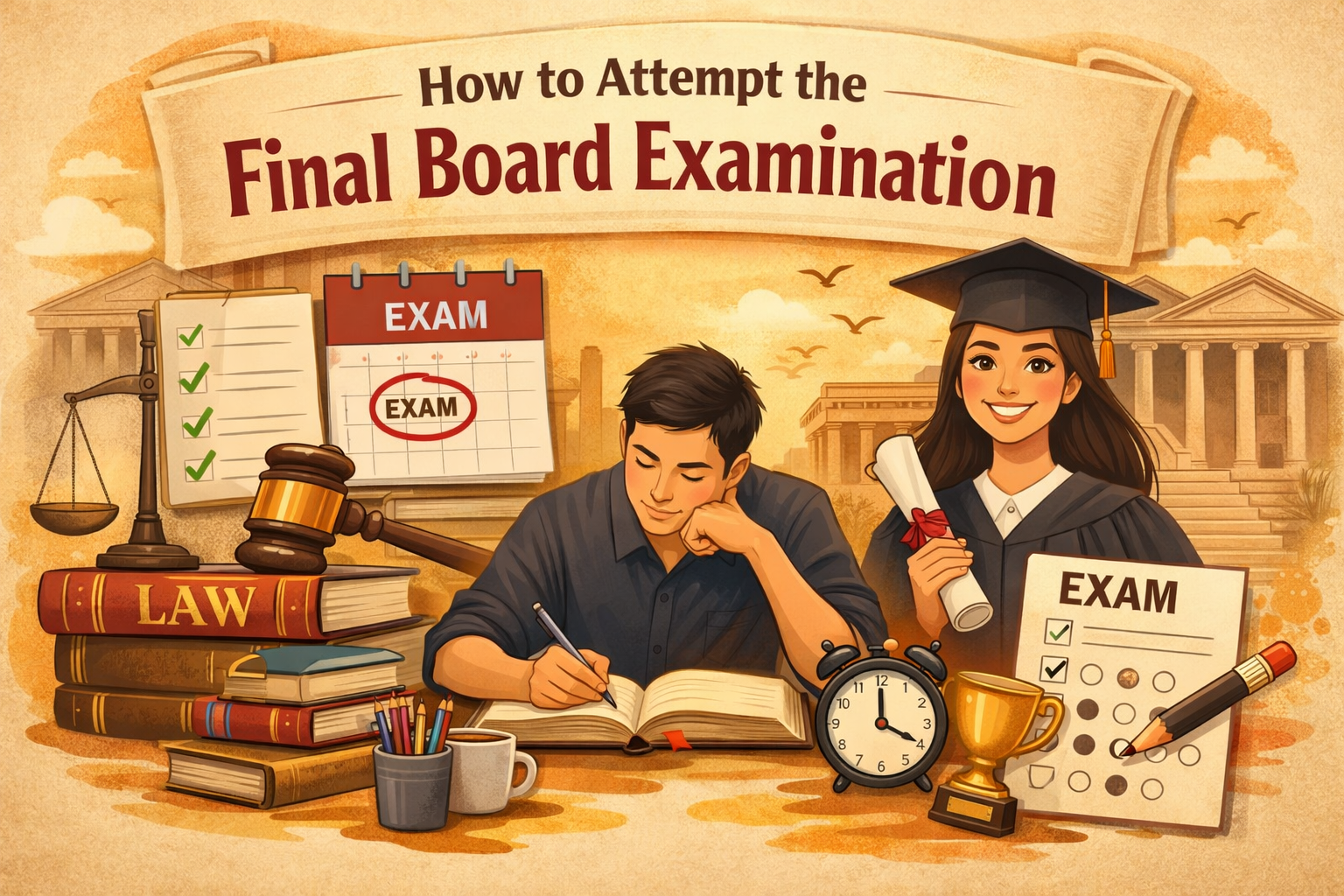
How to Attempt the Final Board Examination: A Smart Student’s Guide
Board examinations are not just a test of how much you know—they are a test of how smartly you write what you know. Every year, students lose marks not because they don’t understand concepts, but because of poor time management, avoidable mistakes, or lack of proper revision.
This blog will walk you through a clear, practical, and proven approach to attempt your final board examination in a way that maximizes your score.
A. Start With the Golden 3 : 1 Rule
A three-hour board paper should never be treated as three hours of nonstop writing. The smartest students divide their time wisely.
Use:
- 2 hours and 15 minutes to attempt the paper
- 45 minutes purely for revising the answer sheet
Revision is where marks are actually saved. Revise once, revise twice, revise as many times as possible—right till the final bell.
B. Time Is Your Biggest Asset—Monitor It Constantly
Keep checking the clock to ensure you are on track. If you realize you’re falling behind, speed up immediately.
There is one rule you must strictly follow:
Do not spend more than 2 minutes on a question if you are stuck.
If you can’t think of the solution:
- Move to the next question
- Come back after attempting a few others
- Try again after completing the paper
- If it still doesn’t click, try once more after the first round of revision
Remember this always:
A smart attempt beats a perfect attempt.
C. Minimise Calculations Wherever Possible
Heavy calculations increase stress and multiply the chances of silly mistakes. Many calculations are simply unnecessary.
Avoid converting fractions into decimals unless the question specifically asks for it. There is no need to use π as 3.14 unless mentioned. Do not multiply π (22/7) and convert intermediate values into decimals. Instead, reduce fractions to their lowest form and keep calculations clean.
Be extra alert when you see multiples of 7 or 11, as they often cancel out with π (22/7).
D. Keep Rough Work Clean and Clearly Separated
Rough work is allowed—but messy work is not.
Your final answers should be clearly separated from rough calculations. Avoid scribbling or overwriting. If a correction is required, make one clean cut only. A neat answer sheet improves readability, and better readability leads to better evaluation.
E.Revise Like an Evaluator, Not Like a Student
While revising, don’t think like the person who wrote the paper. Think like the person who is checking it.
Ask yourself:
- Have I read the question correctly?
- Was it asking for correct or incorrect?
- Was it about real roots or not real roots?
- Did I confuse mirror and lens?
- Did I use diameter instead of radius, or vice versa?
A simple habit can save many marks:
Read each question twice before finalising the answer.
F. Don’t Ignore Diagrams
If a diagram is required, it must be drawn—even if a figure is already given in the question paper.
Always draw diagrams with a pencil only. An unlabelled diagram is considered an incomplete answer, so label every part that you remember. Diagrams play a crucial role in subjects like Maths and Science, and skipping them can cost easy marks.
G. Question Numbers Matter More Than You Think
Incorrect or unclear question numbering irritates the evaluator and can even lead to skipped answers.
Make sure:
- All question numbers are marked correctly
- Sub-parts are clearly indicated
This small habit creates a good impression and makes evaluation smoother.
H. Define Assumed Variables Clearly
If you assume variables like x or y, always mention what they represent after solving the question.
This is especially important in:
- Father–son problems
- Upstream–downstream problems
Never leave the evaluator guessing what your variables mean.
I. Highlight the Final Answer Clearly
The evaluator should never have to search for your answer.
At the end of every question, clearly highlight the final answer. This single habit can make a big difference in how your paper is evaluated.
J. Redo All Calculations—Yes, All of Them
Silly mistakes can happen even in the simplest calculations. That’s exactly why they’re called silly mistakes.
During revision, quickly redo calculations—especially in questions involving:
- Mean, median, and mode
- Quadratic equations
- Arithmetic Progressions
- Surface area and volume
- Matrices and determinants
- Linear Programming
- Probability
It may feel boring, but it saves marks where you least expect errors.
K. Confirm That All Questions Are Attempted
Before submitting the paper:
- Check that every question and sub-part has been attempted
- Never attempt both questions in an internal choice
- Do not try to outsmart the evaluator—it never works
A simple trick helps here: tick each question in the question paper only after attempting it in the answer sheet.
L. Special Advice for Chemistry Students
Even if not explicitly asked:
- Write the chemical reaction wherever applicable
- Always balance the chemical equation
An unbalanced equation is considered incomplete, no matter how correct the concept is.
M. Highlight the Formula, Theorem, or Identity Used
For every problem, clearly indicate the formula, theorem, or identity applied. Writing it in brackets while solving the question improves clarity and helps the evaluator understand your approach.
This is best done in the last 10 minutes of revision.
N. Don’t Forget Units
Units are easy to forget when you’re in a hurry, but answers without units are incomplete.
Whether it’s age in years, length in centimetres, or speed in m/s—always write the unit wherever applicable.
O. Never Leave an Equation Incomplete
An equation is only an equation when both LHS and RHS are present.
Always complete equations properly, especially by bringing them to the form = 0 where required. Leaving equations incomplete can cost unnecessary marks.
Final Words
Board examinations reward clarity, discipline, and smart strategy more than panic or perfection. Your marks are not decided only by how you solve questions, but also by how carefully you revise them.
Stay calm. Follow the strategy. Use the last 45 minutes wisely.
Because in board exams, alertness can convert preparation into performance.
Latest Blogs


Best PCM Coaching Institutes For JEE In Faridabad...
28 Jul, 2026
Best Coaching In Faridabad | Best Coaching
11 Jul, 2026
our leadership
Meet the management team
Meet the management team
leading our vision

Rohan Mittal
B.Tech (IIT Roorkee)
Sagar Mittal
B.Tech (IIT Delhi)
Gaurangi Mittal
M.A. Economics (JMI)